
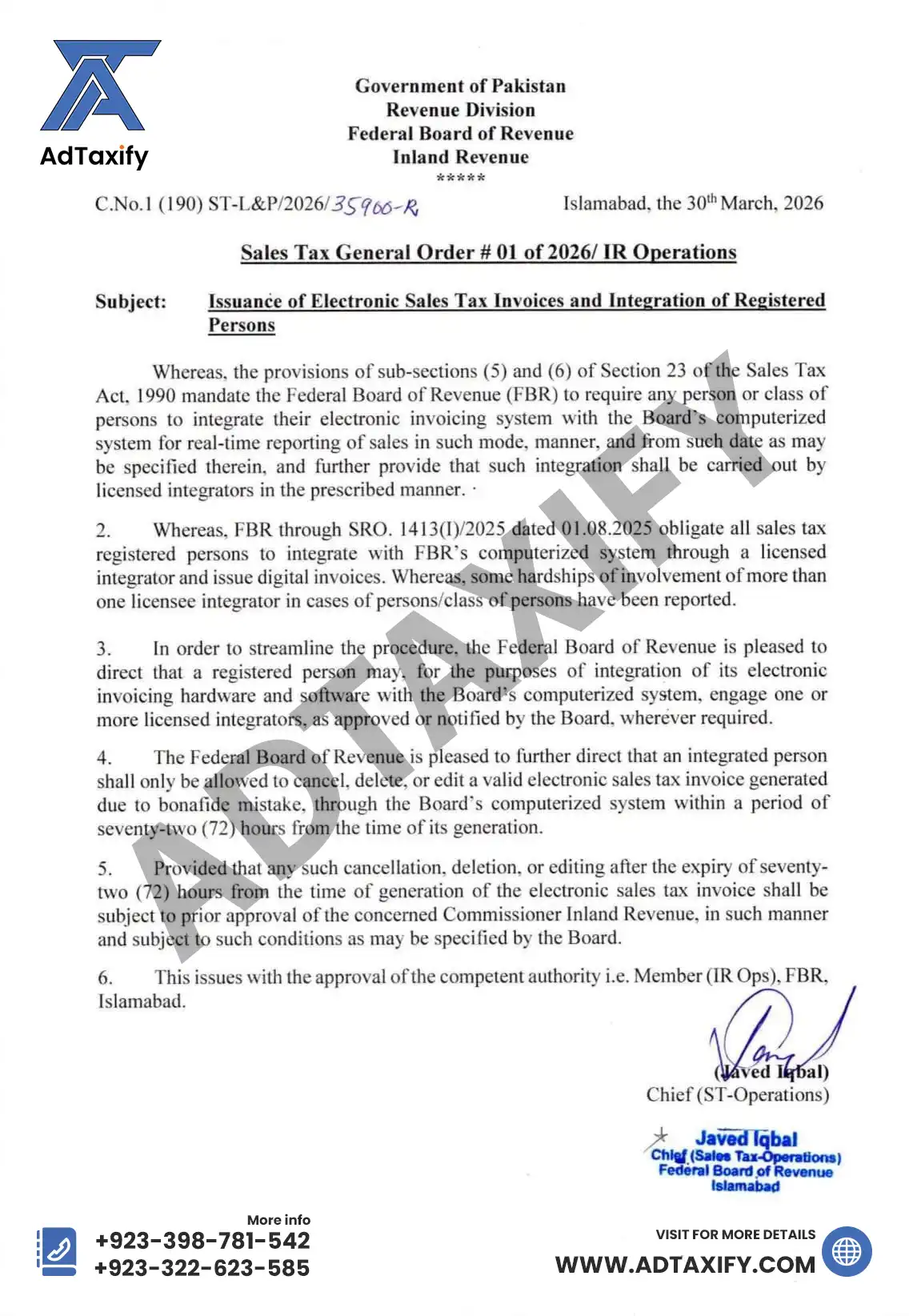
The Federal Board of Revenue (FBR) has taken a major step toward digital transformation by issuing Sales Tax General Order No. 01 of 2026 on March 30, 2026. This new directive focuses on the issuance of electronic sales tax invoices and the integration of registered persons with FBR’s computerized system.
This development marks a significant shift in Pakistan’s taxation system, emphasizing real-time reporting, transparency, and accountability. Businesses registered under sales tax must now align their invoicing systems with FBR requirements to ensure compliance and avoid penalties.
Background and Legal Framework
The order is rooted in Section 23 (Subsections 5 & 6) of the Sales Tax Act, 1990, which empowers FBR to mandate businesses to integrate their invoicing systems with its centralized platform.
Previously, under SRO 1413(I)/2025, businesses were required to connect with FBR through a single licensed integrator. However, this approach created operational challenges, especially for companies using multiple systems or platforms.
To address these issues, the new order introduces flexibility while maintaining strict compliance standards.
Key Features of Sales Tax General Order 01 of 2026
1. Real-Time Sales Reporting
One of the most critical changes is the requirement for real-time reporting of sales invoices.
This means:
- Every sale must be instantly recorded in the FBR system
- Delays or manual entries are no longer acceptable
- Businesses must adopt digital invoicing systems
This step will significantly reduce tax evasion and improve documentation across all sectors.
2. Mandatory Electronic Invoicing
All registered persons are now required to issue electronic sales tax invoices.
Key benefits include:
- Improved accuracy
- Automated record-keeping
- Reduced human error
- Faster tax audits
Electronic invoicing ensures that every transaction is documented and traceable.
3. Integration with FBR System
Businesses must integrate their software/hardware systems with FBR’s platform.
Integration can be done through:
- Licensed integrators
- Approved software solutions
This ensures seamless communication between business systems and the FBR database.
4. Multiple Licensed Integrators Allowed
A major improvement in this order is the permission to work with multiple licensed integrators.
Previously:
- Only one integrator was allowed
Now:
- Businesses can choose multiple approved integrators
- Flexibility for companies using different systems
- Easier scalability and system management
This change resolves a major concern raised by the business community.
5. 72-Hour Invoice Correction Rule
Another important feature is the time limit for editing invoices.
- Businesses can edit, delete, or cancel invoices within 72 hours
- Changes must be made through FBR’s system
After 72 hours:
- Approval from the Commissioner Inland Revenue is required
This ensures:
- Authenticity of records
- Prevention of manipulation or fraud
Impact on Businesses in Pakistan
The implementation of this order will have a widespread impact on businesses.
Positive Impacts
- Increased transparency
- Reduced tax fraud
- Better financial documentation
- Simplified audits
Challenges
- Initial setup cost
- Technical integration issues
- Staff training requirements
However, in the long run, these changes will create a more stable and fair tax environment.
Why This Move is Important for Pakistan
Pakistan is moving toward a fully digital economy, and taxation is a key part of this transition.
This order:
- Strengthens documentation culture
- Improves tax collection
- Encourages compliance
- Reduces the informal economy
It aligns Pakistan with global standards where digital invoicing is already mandatory in many countries.
How Businesses Can Prepare
To comply with this order, businesses should:
- Upgrade their invoicing systems
- Choose reliable licensed integrators
- Train their staff on digital tools
- Monitor real-time reporting processes
- Stay updated with FBR regulations
Early adoption will help businesses avoid penalties and stay competitive.
Role of Professional Tax Consultants
With increasing complexity in tax regulations, professional guidance has become essential.
Tax consultants can help businesses:
- Understand legal requirements
- Implement integration solutions
- Ensure compliance
- Avoid costly mistakes
Conclusion
The FBR Sales Tax General Order 01 of 2026 is a transformative step toward a transparent, digital, and efficient tax system in Pakistan. By enforcing real-time reporting, electronic invoicing, and strict compliance rules, FBR aims to modernize the taxation landscape.
While businesses may face short-term challenges, the long-term benefits far outweigh the initial difficulties. Companies that adapt quickly will gain a competitive advantage in this evolving digital economy.
Call to Action (For Website)
If you need expert guidance on FBR integration, tax compliance, or business consultancy, Adtaxify is here to help.
🌐 Visit: www.adtaxify.com
📞 Call/WhatsApp: +923-398-781-542 | +923-322-623-585